Leonard Irving Howarth was born on 6 February 1925, in Peru, Illinois, the fourth son of Thomas Sheldon Howarth and Johanna Fitzpatrick Howarth.
The family Leonard was born into was a blend of two immigrant traditions. His paternal grandparents had come to America from England in the years following the Civil War, while his maternal grandparents, the Fitzpatricks, were the first American-born generation of Irish families that had crossed the Atlantic in the mid-1800s—part of the great wave of Irish emigrants still fleeing the aftermath of the Famine years.
Leonard’s father, Thomas, was a veteran of World War I who had enlisted in the U.S. Army at age 26 in September 1917—five months after the U.S. entered World War I. He served as a Cook with Company E of the 349th Infantry. Leonard’s parents , Thomas and Johanna, married in December of that year while he was in the service. Several months after their wedding, the 349th shipped out for France in August 1918, arriving three months before Armistice Day. However, though the war had ended in November 1918, Thomas could not return until the following April. He was discharged two weeks after the birth of their first son, Thomas.
Tragically, Thomas and Johanna lost their first child at just two years old from illness. Their second son, Kenneth, who was born the year before was not yet one year old. By the time Leonard arrived, the family already included brothers Kenneth and Harry, born in 1923. Two more children would follow: Wayne in 1928, and a daughter, Leta Mae, in 1930.
Chicago and the Depression Years
In 1930, the Howarth family lived in a rented home at 3610 64th Place in Chicago, where Thomas worked as an inspector for an automobile company. Leonard was five years old. The country was sliding into the Great Depression, and families like the Howarths—renting, working in the industrial trades, stretching wages across five children — felt its weight.
By 1940, the family had relocated to 2324 Third Street in Peru, Illinois, the same small town along the Illinois River where Leonard had been born.
The Peru of Leonard’s youth was a modest industrial community in the Illinois Valley. The family’s circumstances in 1940 reflect both the Depression’s lingering grip and the resilience of working-class households of the era. Thomas now worked as a machinist for a farm implement company. Living with them was Johanna’s brother, James Fitzpatrick, who worked at the same company as an inspector. Next door lived Thomas’s brother, Harry Howarth, who ran a painting contracting business. The extended family had drawn close, as many families did in those lean years.
Leonard’s oldest brother Kenneth was finishing high school and working part time as a waiter in the high school cafeteria. Leonard himself was fifteen, attending LaSalle-Peru Township High School.
The Draft, and Three Brothers at War
The Japanese attack on Pearl Harbor on 7 December 1941, changed everything for the young men of Leonard’s generation. Within months, his older brothers were making their way toward military service.
Harry was the first to go, enlisting in the U.S. Army Air Corps on 9 January 1943. By November of that year, he was a Corporal with the 74th Troop Carrier Squadron in the 434th Troop Carrier Group before being transferred to the Headquarters Squadron of the IX Troop Carrier Command.
Kenneth enlisted in the U.S. Army on 30 March 1943, and was eventually assigned to Company L of the 143rd Infantry Regiment, part of the 36th Infantry Division, which was fighting its way up the Italian peninsula.
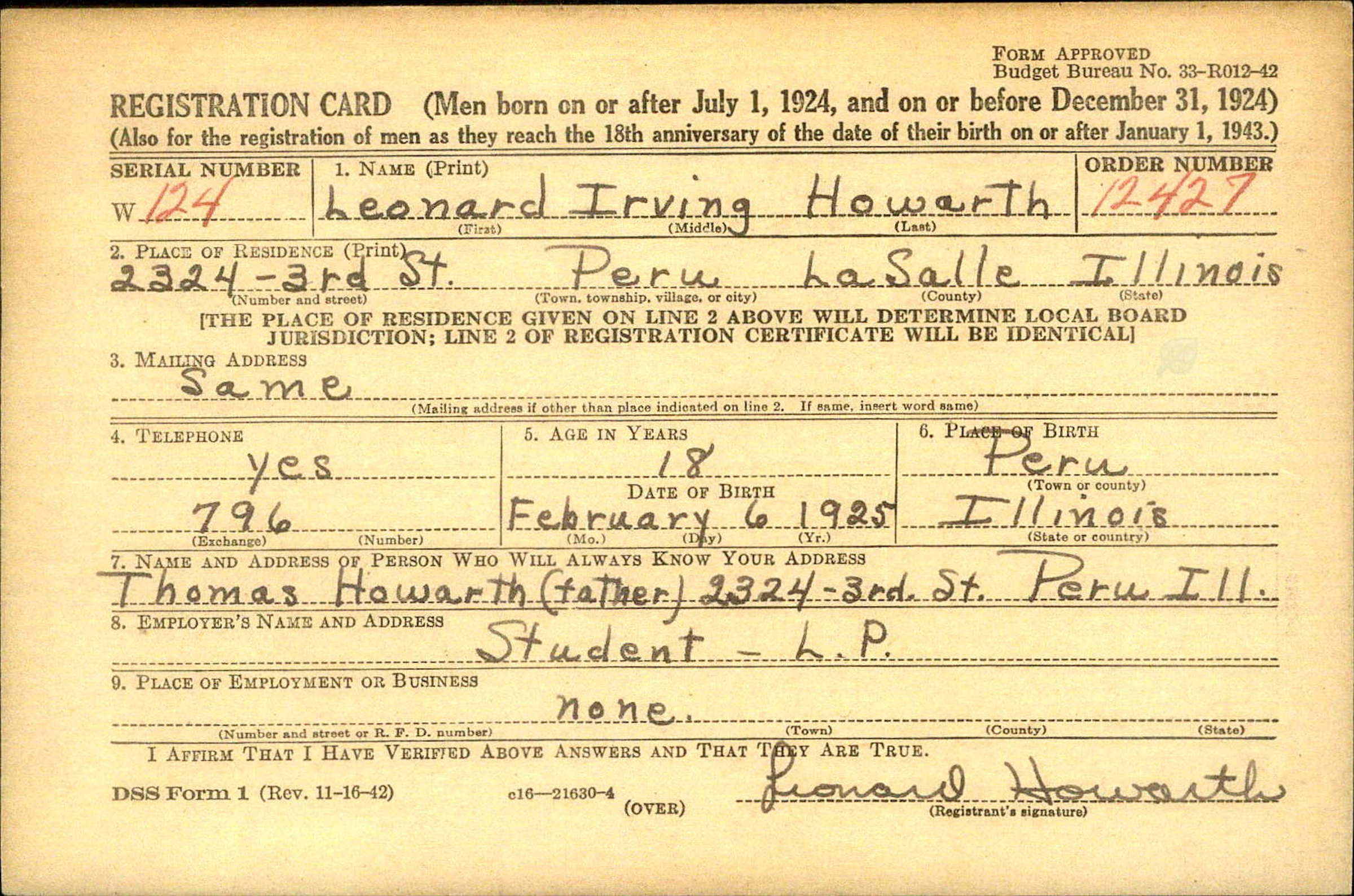
Leonard was still in high school when his turn came. He registered for the draft on his 18th birthday in 1943. The registration card recorded a young man standing 6 feet tall, weighing 150 pounds, with blue eyes and brown hair. He enlisted on 21 June 1943, given service number 36672551, and eventually assigned to Company A of the 34th Tank Battalion, part of the 5th Armored Division—the “Victory Division.”
In February 1944, Leonard’s parents received tragic news; their son Kenneth was missing in action near Cassino, Italy—one of the most brutal and costly engagements of the Italian campaign. The family endured the anguish of not knowing, until word eventually came that he was alive but a prisoner of war, held at Stalag 2B Hammerstein in German-occupied Pomerania.
Then, on 3 June 1944—just three days before the Allied landings at Normandy—Thomas Sheldon Howarth died, at age 53. The man who had survived the First World War, raised a large family through the Depression, and sent three sons off to fight in a second world war did not live to see it end. Somewhere in France or England, Leonard may have received word of his father’s death, though the exact circumstances remain unknown.
The 5th Armored Division and the Road to Germany
The 5th Armored Division had arrived in the European Theater in the spring of 1944, landing in Normandy in late July and participating in the breakout from the bocage country that followed. By the autumn of 1944, the division was pushing through Luxembourg and into Germany itself, one of the first American units to cross the German border.
The division operated under a “combat command” structure, a flexible organizational system used by U.S. armored divisions in the Second World War. Rather than fixed brigades, units were grouped into Combat Command A (CCA), Combat Command B (CCB), and a smaller reserve, Combat Command R (CCR). This allowed commanders to tailor task forces to the situation at hand. The 34th Tank Battalion, like the other armor in the division, worked within this structure, its companies shifting between assignments as the campaign demanded. During December 1944, Company A of the 34th Tank Battalion was operating under CCA.
The Hürtgen Forest
The Hürtgen Forest was a place that swallowed men and machines alike. Stretching across some fifty square miles of dense, dark woodland along the German-Belgian border southeast of Aachen, it was terrain that negated nearly every American advantage. Tanks could barely maneuver. Air support was useless under the canopy. Artillery fire fragmented in the treetops, raining steel downward onto troops in the open. The Germans had fortified the forest over months.
American forces had been fighting in the Hürtgen since September 1944, and the battle had already consumed several divisions by the time the 34th Tank Battalion arrived. From late November through December, the battalion was engaged in that grinding, costly forest fighting—cold, muddy, costly in ways that even veterans of Normandy found shocking.
Then, on 16 December 1944, German forces launched a massive surprise counteroffensive through the Ardennes to the south—what would become known as the Battle of the Bulge. The entire Allied front was thrown into crisis. Units across the region were redirected, reorganized, and thrown into the breach.
On 20 December 1944, the 34th Tank Battalion was ordered to move toward the village of Winden, tasked with supporting the 15th Infantry Regiment and seizing the high ground to the west of the village. It was a mission like dozens of others across that desperate, frozen December—a small piece of a vast and chaotic battle.
That day, three men of the battalion were killed in action. Private Leonard Irving Howarth was one of them. He was nineteen years old.
Burial and Return
Leonard was initially buried at the Henri-Chapelle American Cemetery in Belgium, one of the largest American military cemeteries in Europe, established on ground that had been liberated just months before. Thousands of men who fell in the fighting in the Rhineland and the Ardennes were laid to rest there.
After the war, Johanna Howarth made the decision that many American mothers made—she wanted her son home. She requested that Leonard’s remains be returned to Illinois, and in December 1947 he was laid to rest in Saint Vincent Cemetery in LaSalle, Illinois, in a grave near his father and near the tiny grave of the oldest Thomas, who had died in infancy a quarter century before.
The Army’s handling of Leonard’s personal effects added a quiet, painful aspect to the story. His mother received his belongings in late December 1944—a wallet, religious items, photographs, a military missile, his divisional shoulder patch, knives, a pen, and souvenir coins. There was also cash owed to him, but military records apparently required this to be sent to his father, whose death the Army had not been notified of. Whether that error was ever corrected is not known.
PVT Leonard Howarth was posthumously entitled to the following medals: American Campaign Medal, WW2 Victory Medal, European-African-Middle Eastern Campaign Medal.
Honoring Those Who Served
In the summer of 1945, as the war in Europe had ended and the war in the Pacific was drawing to its close, Johanna’s family—the Fitzpatricks—gathered for a picnic dinner. Seventy-two relatives and friends came together, and those in uniform were honored:
- Leonard Howarth, killed in action in Germany.
- Corporal William Fitzpatrick, Jr., who had spent thirty months in the jungles of the New Hebrides in the Pacific and was home on a thirty-day furlough.
- Private First Class Kenneth Howarth, who had been captured near Cassino, Italy, and held as a prisoner of war in a German camp for fifteen months—and who had come home.
- Harry Howarth, who was still serving in Germany.
- Chief Petty Officer Dave Fitzpatrick, who had served nearly nine years in the U.S. Navy and was home from Africa.
- Chief Petty Officer Leo Fitzpatrick, on leave from Atlee, Alaska.
Six men from one extended family. Five of them came back.
Leonard’s brother Wayne would also serve in the Army after his graduation from high school. Leonard’s mother, Johanna Howarth, lived for nearly four more decades after burying her husband and son. She passed away in 1982. She had sent three boys to war, welcomed two of them home, and carried the absence of the third for the rest of her life.

This story is part of the Stories Behind the Stars project www.storiesbehindthestars.org This is a national effort of volunteers to write the stories of all 400,000+ of the US WWII fallen here on Fold3. Can you help write these stories? If you noticed anything missing in this profile, you may contact the author. Click on the author’s name located at the bottom of the story page next to the words “added by.”
- SBTSProject/Illinois/LaSalle
- SBTS Historian: Pam Broviak
Sources:
- 1900 U.S. Census, Richard Howarth, Ancestry.
- 1900 U.S. Census, Thomas Shelton, Ancestry.
- 1900 U.S. Census, Patrick Fitzpatrick, Ancestry.
- 1920 U.S. Census, Thomas Howarth, Ancestry.
- 1930 U.S. Census, Thomas Howarth, Ancestry.
- 1940 U.S. Census, Thomas Howarth, Ancestry.
- “United States records,” images, FamilySearch (https://www.familysearch.org/ark:/61903/3:1:3Q9M-CS1G-3139 : 3 May 2026), image 4024 of 6000; National Archives and Records Administration. Image Group Number: 105208553.
- “U.S., World War II Army Enlistment Records, 1938-1946,” Harry J. Howarth, Ancestry.
- “U.S., World War II Army Enlistment Records, 1938-1946,” Kenneth R. Howarth, Ancestry.
- “Roster of company “E” 349th Infantry,” 31 August 1918, Howarth Thomas, FamilySearch.
- State of Illinois, Certificate of Death, Thomas Joseph Howarth, 1921, No. 28491, FamilySearch (https://www.familysearch.org/ark:/61903/3:1:3QS7-L9KB-WRZ6 : accessed 3 May 2026).
- State of Illinois, Certificate of Death, Thomas Howarth, 1944, No. 22503, FamilySearch (https://www.familysearch.org/ark:/61903/3:1:3QS7-89GX-TF79 : accessed 3 May 2026).
- “U.S., World War II Draft Cards Young Men, 1940-1947,” Leonard Irving Howarth, Ancestry.
- Record Group 64: Records of the National Archives and Records Administration Series: Morning Reports, Morning Reports for December 1943: Roll 120 (2 of 3), image 117 of 1000, NARA.
- Record Group 64: Records of the National Archives and Records Administration Series: Morning Reports,
- Morning Reports for September 1944: Roll 482, image 109 of 2084, NARA.
- Record Group 64: Records of the National Archives and Records Administration Series: Morning Reports, Morning Reports for July 1944: Roll 656 (3 of 3), image 284 of 431, NARA.
- Record Group 64: Records of the National Archives and Records Administration Series: Morning Reports, Morning Reports for December 1944: Roll 665, image 2077 of 4005, NARA..
- Record Group 64: Records of the National Archives and Records Administration Series: Morning Reports Morning Reports for February 1944: Roll 451 (3 of 4), image 476 of 1000, NARA.
- Record Group 64: Records of the National Archives and Records Administration, Series: Morning Reports, Morning Reports for November 1943: Roll 532 (2 of 4), image 94 of 1000, NARA.
- “Enjoyable Event for Service Men,” Dixon Evening Telegraph, 20 June 1945, p. 5, Col. 3, Ancestry.
- “U.S., Headstone Applications for Military Veterans, 1861-1985,” Leonard I Howarth, Ancestry.
- “US 5th Armored Division in Normandy and France,” Flames of War website.
- Anton J. Suppes, “Engaging the Germans & War Stories, 3rth Tank Battalion, 5th Armored Division website.
- After Action Report December 1944, 5th Armored Division website.
- National Archives, World War II Prisoners of War Data File, Kenneth R Howarth.
- Individual Deceased Personnel File (IDPF), Leonard I Howarth, NARA.
- https://www.findagrave.com/memorial/222346025/harry-j.-howarth
- https://www.findagrave.com/memorial/126354567/johanna-howarth
- https://www.findagrave.com/memorial/126354655/leonard-howarth
