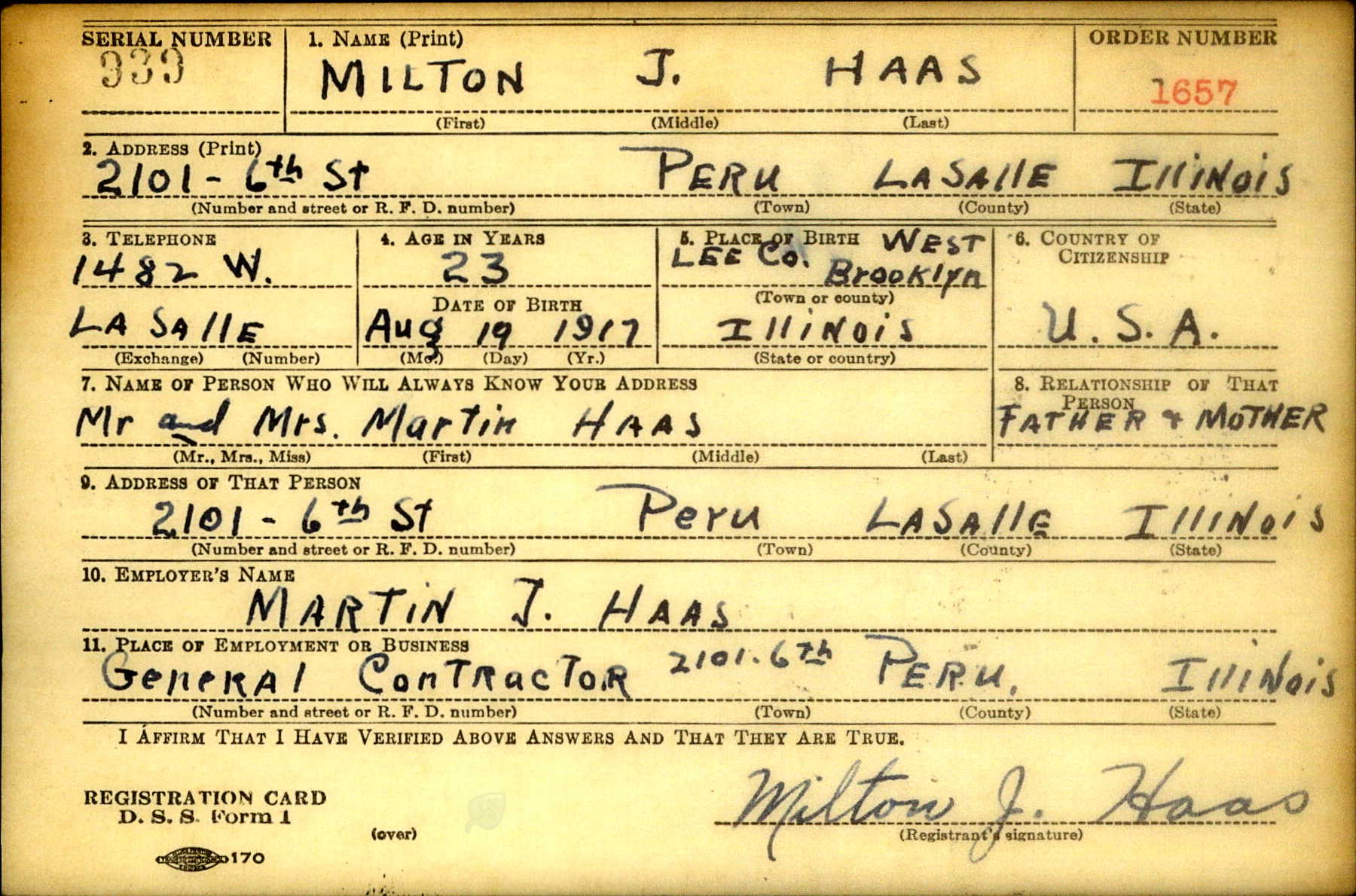
Milton Joseph Haas came into the world on a summer day, 19 August 1917, in West Brooklyn, a small community in Lee County, Illinois. He was the second son of Martin and Anna (Graf) Haas joining his older brother Ivan, who had been born three years earlier in 1914.
When Milton was still a toddler, the family relocated to Peru, Illinois, settling into a rented home at 2019 Second Street. Martin found steady work as a mechanic at a local garage. Milton attended St. Joseph’s parochial school, where the rhythms of Catholic faith and community shaped his early character. From there, Milton went on to LaSalle-Peru Township High School.
As the years passed, the Haas family put down deeper roots. Martin and Anna purchased a home at 2101 Sixth Street, a modest but meaningful step for a working-class family in those years between the wars. Martin eventually set aside his mechanic’s tools and returned to the trade that had run in his family’s blood—carpentry—ultimately building his own contracting business in Peru.
Milton grew into a young man well regarded in his community. He joined the Peru Catholic Order of Foresters, the carpenter’s union, and the Sacred Heart League of St. Joseph’s Church, threading himself into the social and spiritual fabric of Peru’s Catholic community. He was known as an active sportsman and a well-known golfer, holding membership at the South Bluff Country Club. By all accounts, he was a rooted, purposeful young man connected to his faith, his trade, and his town.
On 16 October 1940, as war clouds gathered over Europe and the Pacific, Milton registered for the draft. He was 23 years old, standing five feet six and a half inches tall, weighing 140 pounds, with brown hair and brown eyes. His brother Ivan registered on the same day. Both young men were working for their father’s contracting business at the time—two brothers side by side, not yet knowing what the coming years would demand of them.
The demand came on 14 September 1942, when Milton was inducted into the United States Army in Chicago and assigned service no. 36371784. He spent the first six months of his service training at Camp Wolters in Texas, one of the Army’s primary infantry replacement training centers during the war, before transferring to Fort Ord along the central California coast.
Milton was assigned to Company F of the 543rd Engineer Boat and Shore Regiment, a specialized unit whose mission was to support amphibious operations—moving troops, vehicles, and supplies from ship to shore under some of the most dangerous conditions the Pacific war had to offer. In the autumn of 1943, the regiment departed for overseas deployment.
The Pacific theater was brutal and unrelenting. In the vast island chains of the Southwest Pacific, General Douglas MacArthur’s forces were grinding their way toward Japan. Units like the 543rd were essential to every amphibious landing, and Milton was part of that effort.
In the late summer of 1944, tragedy struck the Haas family on two fronts. Back in Peru, Milton’s father, Martin, suffered a coronary thrombosis on September 1st. He lingered for more than a week before dying on September 9th, leaving Anna a widow in the home on Sixth Street.
When his father died, Milton was thousands of miles away in the Pacific and may not yet have known he was gone. Three weeks after Martin’s death, on September 30th, Milton was struck by the blast of an aerial bomb at Sansapor on the northwestern tip of New Guinea. The autumn of 1944 had delivered two crushing blows to the Haas family—a father lost at home, a son wounded on a distant shore. Milton returned to duty in October and received the Purple Heart for his wounds.
By early 1945, American forces including Milton’s unit had landed on Mindanao, the large southern island of the Philippines, pressing forward against determined Japanese resistance. It was there, on 10 March 1945—just months before the war’s end—that PFC Milton J. Haas was killed in action, struck in the throat and leg. He was 27 years old.
Milton was laid to rest at Fort William McKinley Cemetery in Manila, Philippines, far from the streets of Peru where he had learned his father’s trade, attended Mass at St. Joseph’s, and walked the fairways of the South Bluff Country Club.
He had been a carpenter’s son, a golfer, a union man, a devoted parishioner—and a soldier who gave everything in the service of his country.
In addition to the Purple Hear, PFC Milton Haas was eligible posthumously for the following awards: American Campaign Medal, WW2 Victory Medal, Asiatic-Pacific Campaign Medal, Marine Corps Good Conduct Medal.

This story is part of the Stories Behind the Stars project www.storiesbehindthestars.org This is a national effort of volunteers to write the stories of all 400,000+ of the US WWII fallen here on Fold3. Can you help write these stories? If you noticed anything missing in this profile, you may contact the author. Click on the author’s name located at the bottom of the story page next to the words “added by.”
- SBTSProject/Illinois/LaSalle
- SBTS Historian: Pam Broviak
Note, the information for this story was researched by Pam Broviak and the story developed with AI assistance and final editing by Pam Broviak.
- Sources:
- 1920 U.S. Census, Martin Haas household, Ancestry.
- 1930 U.S. Census, Martin Haas household, Ancestry.
- 1940 U.S. Census, Martin Haas household, Ancestry.
- “U.S., World War II Draft Cards Young Men, 1940-1947,” Ivan A. Haas, Ancestry.
- “U.S., World War II Draft Cards Young Men, 1940-1947,” Milton J. Haas, Ancestry.
- “U.S., World War II Army Enlistment Records, 1938-1946,” Milton J. Haas, Ancestry.
- “Illinois, U.S., Deaths and Stillbirths Index, 1916-1947,” August Haas, Ancestry.
- “West Brooklyn,” Dixon Evening Telegraph, p. 2, col. 1, Newspapers.com.
- “Man, 64, Hit by Auto Dies,” Rockford Register-Republic, 20 February 1950, p. 1, col. 5, GenealogyBank.
- Morning Reports for April 1944: Roll 726 (4 of 5), 543rd Engineer Boat and Shore Regiment, image 133 of 1000, NARA.
- “US, WWII Hospital Admission Card Files, 1942-1954,” October 1944, Milton J. Haas, Fold3.
- “US, WWII Hospital Admission Card Files, 1942-1954,” March 1944, Milton J. Haas, Fold3.
- Morning Reports for September 1944: Roll 594, 30 September 1944, 543rd, image 2828 of 4083, NARA.
- Morning Reports for October 1944: Roll 501, 1 October 1944, 543rd, image 1305 of 4455, NARA.
- Morning Reports for October 1944: Roll 501, 6 October 1944, 543rd, image 1310 of 4455, NARA.
- Morning Reports for October 1944: Roll 501, 13 October 1944, 543rd, image 1317 of 4455, NARA.
- Morning Reports for October 1944: Roll 501, 21 October 1944, 543rd, image 1325 of 4455, NARA.
- Morning Reports for October 1944: Roll 485, Registrar Section, 29th Evacuation Hospital, image 3435 of 3608, NARA.
- Morning Reports for October 1944: Roll 485, Registrar Section, 29th Evacuation Hospital, image 3462 of 3608, NARA.
- Morning Reports for October 1944: Roll 485, Registrar Section, 29th Evacuation Hospital, image 3497 of 3608, NARA.
- “Lee Co. Native is Killed in Fighting,” Dixon Evening Telegraph, 7 April 1945, p. 1, col. 6, Newspapers.com.
- “U.S., World War II and Korean Conflict Veterans Interred Overseas,” Milton J. Haas, Ancestry.
- https://www.findagrave.com/memorial/56770366/milton-j-haas
