Stanley Albert Noramczyk Jr. was born on 7 November 1923, in Peru, Illinois, the firstborn son of Stanley and Martha (Romanowski) Noramczyk. He grew up in a household that would eventually include three younger siblings: Mildred, born in 1925; Ruth, born in 1930; and Robert, born in 1937. As the eldest, Stanley came of age during a period marked by both family growth and the broader uncertainties of the Great Depression.
Loss came early. In early 1926, when Stanley was just two years old, his paternal grandfather, Joseph Noramczyk, died of tuberculosis. Several years later in May 1934 when Stanley was ten years old, he lost his maternal grandfather, Michael Romanowski. Both grandfathers had been immigrants and lived in the LaSalle-Peru area.
Growing Up in Peru
By 1930, the Noramczyk family firmly established roots in their community. They owned a home at 2010 Pulaski Street in Peru, and Stanley’s father worked as a caster at Westclox—a prominent clock manufacturer and central source of employment in the Illinois Valley. In 1940 the family still lived in their home on Pulaski and Stanley’s father, now working as a machine operator, was still at Westclox. Stanley was nearing the completion of his high school years.
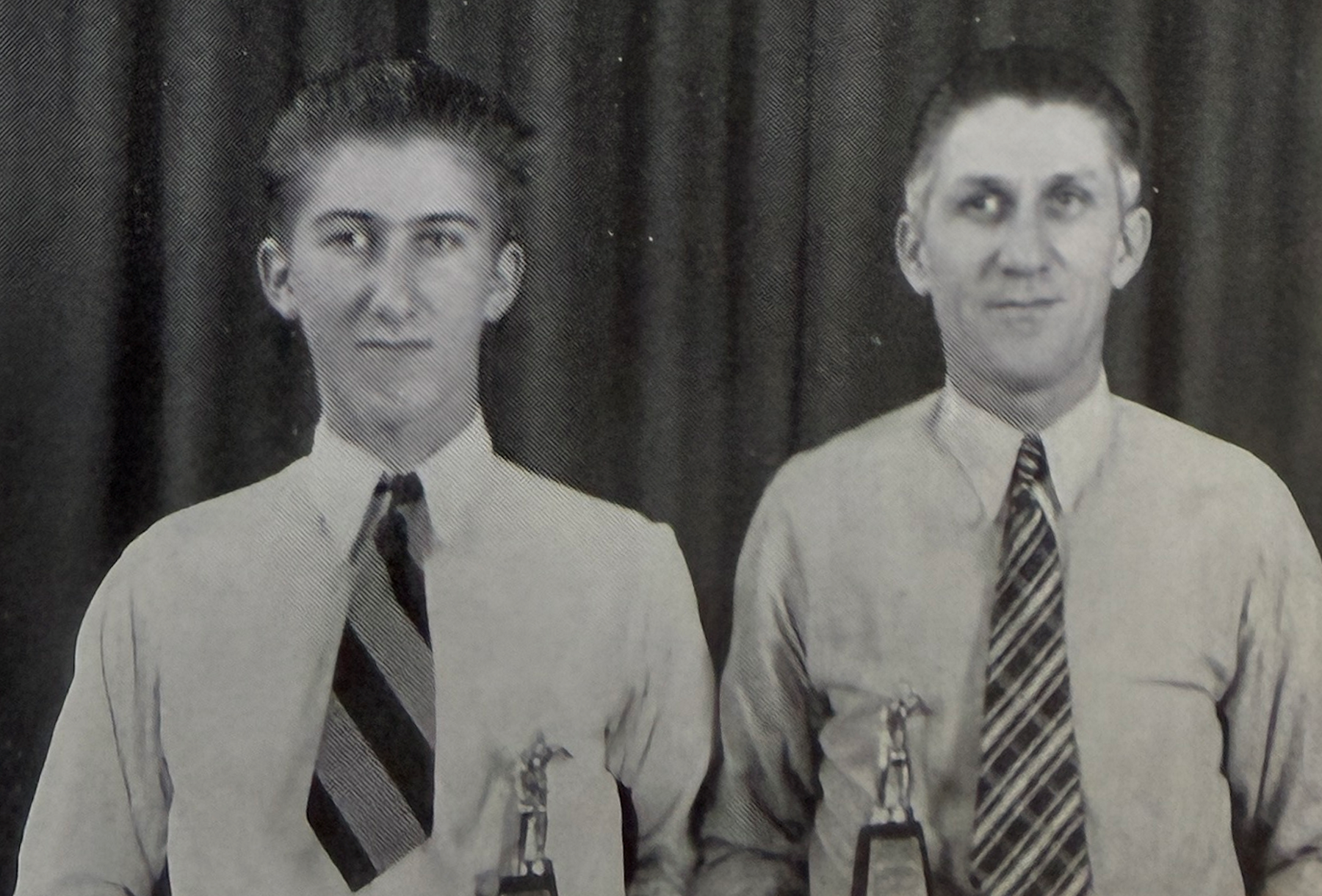
Westclox, his father’s employer, provided more than just a workplace; it was a social and cultural anchor in the community. In April 1941, the company hosted a Father–Son–Daughter bowling tournament. Stanley and his father entered together and won first place, their photograph appearing in Tick Talk, the company magazine. It is a revealing moment—father and son recognized together in their hometown, only months before global war would reshape their lives.
Answering the Call
On 30 June 1942, at 18 years of age, Stanley registered for the draft. He stood five feet nine and a half inches tall, weighed 162 pounds, and had blue eyes and dark brown hair. Six months later, on 30 January 1943, he enlisted in the United States Army at Peoria, Illinois, receiving service number 36445588.
His training took him south. By September 1943, he had reached the rank of Technician Fifth Grade (TEC5) while stationed at Herbert Smart Airport in Macon, Georgia, assigned to the 801st Chemical Company. In December 1943, he was transferred to John B. Stetson University in DeLand, Florida, where the Army utilized university facilities for wartime training. But not long after he transferred to Clemson University in South Carolina.
Soon after Stanley’s transfer to Clemson, the U.S. Army severely cut back the Army Special Training Program (ASTP) through which Stanley had been trained. Because of the Army’s great need for rifleman, many ASTP participants were sent to infantry units to serve as replacements.
So, by the summer of 1944, Stanley was stationed at Fort Jackson, South Carolina, as a private in Company L, 346th Infantry Regiment, 87th Infantry Division—part of a formation that would soon enter combat in Europe. On 4 July 1944, he was promoted to Private First Class, and less than two months later, on 28 August 1944, he advanced to Sergeant.
The 87th Infantry Division
At Fort Jackson, Stanley found camaraderie among his fellow soldiers. He played shortstop on the company baseball team, forming bonds that extended beyond military duty. Years later, a surviving teammate would recall on of their final games before deployment, noting that nearly half the men on the field that day would later be killed in action—a stark reflection of what lay ahead.
In October 1944, the division departed for England aboard the Queen Elizabeth. On 28 November 1944, they landed in France. The war in Europe had entered one of its most demanding phases.
On 15 December 1944, Stanley was awarded the Combat Infantryman Badge, marking his direct participation in ground combat.
Into the Heart of the War
From France, the regiment advanced into Belgium during the harsh winter campaign following the Battle of the Bulge. They continued into Luxembourg and then into Germany, pushing steadily against entrenched defenses.
By February 1945, Stanley’s unit was engaged along the Siegfried Line, Germany’s heavily fortified western barrier. The terrain was perilous—dense woods laced with mines and booby traps, where each patrol carried grave risk.
It was here that Stanley was wounded. He triggered a booby trap, suffering a fractured tibia along with additional wounds to his arm. Evacuated to a field hospital, he received penicillin and a blood transfusion, but his injuries proved too severe. Staff Sergeant Stanley Albert Noramczyk Jr. died on 11 February 1945 at the age of twenty-one.
Coming Home
In 1949, Stanley’s remains were returned to the Illinois Valley. A Mass was held at St. Valentine’s Church, attended by local veterans and community members honoring one of their own. On 30 March 1949, he was laid to rest at St. Hyacinth’s Cemetery in LaSalle, Illinois.
For his service, he was posthumously awarded the Bronze Star Medal. He was also entitled to the American Campaign Medal, the World War II Victory Medal, the European–African–Middle Eastern Campaign Medal, and the Army Good Conduct Medal.
A Life Remembered
Stanley Noramczyk was, before all else, a son, a brother, and a member of his community. He bowled with his father and won. He played ball with his friends. He lived an ordinary life in a small Illinois town until called to serve in extraordinary circumstances.
He carried that responsibility faithfully from the streets of Peru to the forests along Germany’s frontier. When he returned home, it was not as he had left, but he was not forgotten. He remained part of the community that had shaped him and continued to remember him.
May he rest in peace.

This story is part of the Stories Behind the Stars project www.storiesbehindthestars.org This is a national effort of volunteers to write the stories of all 400,000+ of the US WWII fallen here on Fold3. Can you help write these stories? If you noticed anything missing in this profile, you may contact the author. Click on the author’s name located at the bottom of the story page next to the words “added by.”
- SBTSProject/Illinois/LaSalle
- SBTS Historian: Pam Broviak
Sources:
- 1930 U.S. Census, Stanley Noramczyk Sr., Ancestry.
- 1940 U.S. Census, Stanley Noramczyk Sr., Ancestry.
- “U.S., World War II Draft Cards Young Men, 1940-1947,” Stanley Albert Noramczyk Jr., Ancestry.
- “U.S., World War II Draft Cards Young Men, 1940-1947,” Stanley Luke Noramczyk, Ancestry.
- “U.S., World War II Army Enlistment Records, 1938-1946,” Stanley A Noramczyk, Ancestry.
- “U.S., World War II Hospital Admission Card Files, 1942-1954, Stanley A Noramczyk, Ancestry.
- “U.S., Headstone Applications for Military Veterans, 1861-1985,” Stanley Noramczyk, Ancestry.
- “Mildred D. “Millie” Koscielski,” 11 January 2022, News-Tribune, p. a12, Newspapers.com (https://www.newspapers.com/image/802637715/ : accessed 29 April 2026).
- https://www.findagrave.com/memorial/160005407/ruth-m.-noramczyk
- https://www.findagrave.com/memorial/185838346/robert-carl-noramczyk
- State of Illinois Certificate of Death, Joseph Naramczyk, No. 1634, 1926, FamilySearch.
- State of Illinois Certificate of Death, Michael Romanowski, No. 20425, 1934, FamilySearch.
- Record Group 64: Records of the National Archives and Records Administration Series: Morning Reports, Morning Reports for March 1944: Roll 266 (3 of 4), image 696 of 1000, NARA.
- Record Group 64: Records of the National Archives and Records Administration Series: Morning Reports, Morning Reports for December 1943: Roll 115 (3 of 4). image 93 of 1000, NARA.
- Record Group 64: Records of the National Archives and Records Administration Series: Morning Reports, Morning Reports for February 1944: Roll 35 (1 of 3), image 768 of 1000, NARA.
- Record Group 64: Records of the National Archives and Records Administration Series: Morning Reports, Morning Reports for September 1943: Roll 487 (3 of 4), image 635 of 1000, NARA.
- Record Group 64: Records of the National Archives and Records Administration Series: Army General Orders, FICHE_1367, image 34 of 198, NARA.
- Record Group 64: Records of the National Archives and Records Administration Series: Morning Reports, Morning Reports for August 1944: Roll 54, image 3560 of 3645, NARA.
- Record Group 64: Records of the National Archives and Records Administration Series: Morning Reports, Morning Reports for February 1944: Roll 382 (4 of 4), image 271 of 425, NARA.
- Record Group 64: Records of the National Archives and Records Administration Series: Morning Reports, Morning Reports for July 1944: Roll 95 (2 of 4), image 697 of 1000, NARA.
- “A Historical and Pictorial Record of the 87th Infantry Division in World War II, 1942–1945, Golden Acorn, Fold3.
- 346th Infantry, Always and Everywhere Faithful, 87th Infantry Division Website.
- “Father-Son-Daughter Winners,” Tick Talk, April 1941, Vol. 26, Num. 4, page 25.
- “More on 87th Baseball Teams, Golden Acorn News, Vol. 40, Issue 1, March 1998, 87th Infantry Division Website.
- Louis E. Keefer, “Birth and Death of the Army Specialized Training Program,” Army History, Winter 1995, Washington, D.C., Jstor.
- National Centers for Environmental Information, Record of Climatological Observations, March 1949, Peru, Illinois.
- https://www.findagrave.com/memorial/61878134/stanley-a.-noramczyk
