Leroy Albert Carbine was born on 25 January 1914, in Chicago, Illinois, to Alphonsis and Minnie (O’Brien) Carbine. His parents had married two years earlier, on 19 June 1912, also in Chicago. By 1920, the Carbine family had moved to LaSalle, Illinois, where they lived on Second Street. Leroy’s father worked at a local cement company, providing a stable livelihood for his family. Over the next decade, the family relocated to the Deer Park area of nearby Oglesby, Illinois. By 1930, Leroy’s father had advanced in his career, becoming an operator at the cement company.
In about 1937, Leroy married Olga Daffara, daughter of Charles and Katherine Daffara. The couple welcomed their first child, a daughter named Colleen, in late 1937. By the time the 1940 U.S. Census was taken, Leroy, Olga, and their two-year-old daughter were living at 317 Walnut Street in Oglesby. Leroy was working as a laborer at the Lehigh Cement Company, likely following in his father’s footsteps.
That same year, with war raging across Europe, the United States instituted a draft. Leroy was part of the first group who registered on 16 October 1940. That year, at 27 years old, he stood 5 foot 8 inches tall and weighed 150 pounds, with blue eyes and brown hair. By the end of the next year, the United States had entered the conflict. Leroy’s brother Henry was already in the Army having enlisted earlier that summer. Their brother Joseph was drafted a year after the United States declared war and enlisted in the Army on 10 December 1942. During this time, Leroy and Olga had their second child—a daughter.
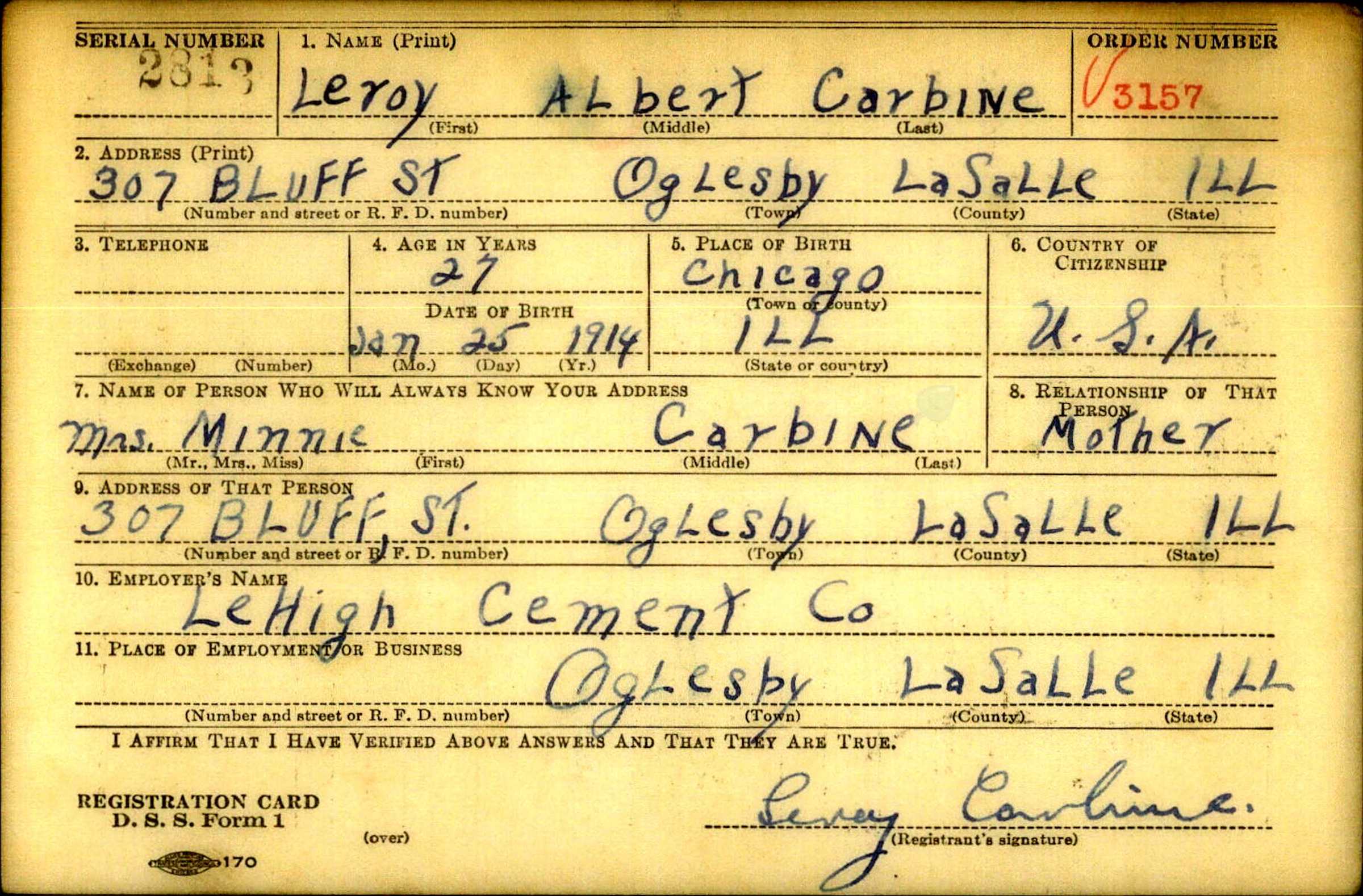
As the war continued and the Allies made their way onto the European continent, Leroy was eventually called to serve his country. He enlisted in the U.S. Army on 14 July 1944. Ultimately, Leroy was assigned to Company F of the 309th Infantry Regiment in the 78th Infantry Division, known as the “Lightning Division.”
The 78th Infantry Division was deeply engaged in the European theater during the winter and spring of 1945. By March 1945, the division had been fighting through the Battle of the Bulge and advancing into Germany. The 309th Infantry Regiment, part of this larger push, was heavily involved in the offensive to seize control of strategic towns and bridges along the Rhine River. These operations were critical in breaking through Germany’s final defensive lines and forcing a retreat.
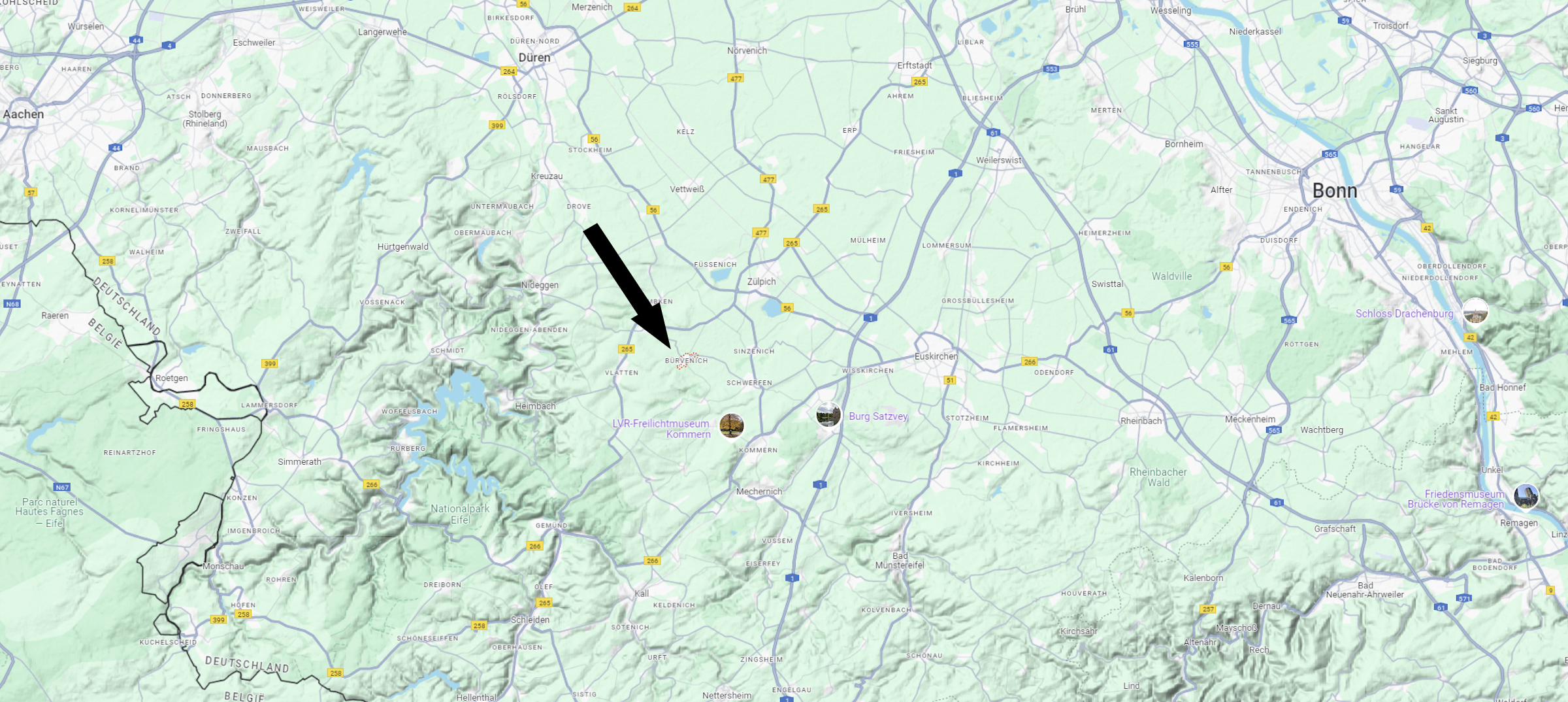
PFC Leroy Albert Carbine lost his life on 3 March 1945, while his unit advanced through Germany from Burvenich to Sinzenich. As they moved through open terrain, the troops were subjected to a barrage of enemy mortar fire, exploiting the exposed landscape. Just days after Leroy’s death, the division played a key role in capturing the strategic city of Remagen and its Ludendorff Bridge, a victory that many believe hastened the end of the war in Europe. Leroy’s sacrifice came amid some of the war’s most intense combat, as American forces continued their determined push into enemy territory. Initially, PFC Carbine was laid to rest at Henri-Chapelle Military Cemetery in Belgium.
After the war, Leroy’s remains were returned to the United States, and in 1948, he was laid to rest at Forest Lawn Memorial Park. Though his life was tragically cut short, Leroy Albert Carbine’s legacy endures. For his service he would have posthumously received the following medals: the American Campaign Medal, WW2 Victory Medal, and the European-African-Middle Eastern Campaign Medal.
List sources:
- 1920 U.S. Census, Alphonis Carbine, Ancestry.
- 1930 U.S. Census, Alphonsio Carbine, Ancestry.
- 1930 U.S. Census, Charles Daffara, Ancestry.
- 1940 U.S. Census, Leroy Carbine, Ancestry.
- Cook County, Illinois, U.S., Birth Certificates Index, 1871-1922, Alphons Leroy Carbine, Ancestry.
- Cook County, Illinois, U.S., Marriages Index, 1871-1920, Alphonsis L. Carbine, Ancestry.
- U.S., World War II Draft Cards Young Men, 1940-1947, Leroy Albert Carbine, Ancestry.
- U.S., Department of Veterans Affairs BIRLS Death File, 1850-2010, Henry C. Carbine, Ancestry.
- U.S., Headstone Applications for Military Veterans, 1925-1970, Leroy A. Carbine, Ancestry.
- U.S., Headstone Applications for Military Veterans, 1925-1970, Joseph Dole Carbine, Ancestry.
- IDPF for Leroy Carbine, National Archives St. Louis.
- “Lightning, The History of the 78th Infantry Division,” Washington Infantry Journal Press, 1947.
- https://www.findagrave.com/memorial/84602326/leroy-albert-carbine
