Stanley Ernest “Bandy” Waskiewicz was born in the fall of 1919 to Joseph and Victoria (Lipinski) Waskiewicz, both Polish immigrants who had come to the United States from northeastern Poland seeking opportunity and stability. Stanley grew up in the industrial community of Peru, Illinois, during a period when immigrant families often found work in factories, mills, and heavy industry along the Illinois River valley.
In 1920, Stanley lived with his family at 1320 Center Street in Peru. His father worked as a laborer at the local zinc company, part of the industrial backbone that supported many working-class families in the area. Life for immigrant laborers and their children was often difficult, with long hours, uncertain employment, and crowded living conditions common throughout industrial towns of the Midwest.
By 1930, the family had moved to a rented home at 819 Brunner Street. That year brought hardship to the Waskiewicz family. Stanley’s father Joseph, who was only forty-nine years old, was no longer working and had been suffering for at least six months from stomach and colon cancer. He died in July 1930, the day before Independence Day. The loss came during the Great Depression, a time when many American families were already struggling financially. Curiously, Stanley was not listed with the household when the census was taken in April of that year, and no clear explanation has been found for his absence from the enumeration.
In the early 1940s, Stanley was employed at National Sheet Metal Company, and his mother had remarried. Although no draft registration card has been located for Stanley, military service soon became a defining part of the family’s story. His brothers Henry and Theodore registered for the draft on 19 October 1940 as the United States increased military preparedness while war spread across Europe and Asia.
After the Japanese attack on Pearl Harbor on 7 December 1941, the United States formally entered World War II. Like many young Americans of his generation, Stanley and his brothers answered the nation’s call to service. Theodore enlisted in the U.S. Army on 25 March 1942, only a few months after America entered the war. Later that summer, another brother, Joseph, registered for the draft and would eventually serve in the 199th Port Company.
Stanley enlisted in the United States Navy on 17 October 1942 in Chicago, Illinois. He reported for recruit training at the Great Lakes Naval Training Station north of Chicago, one of the Navy’s principal training facilities during the war. Following boot training, Stanley was assigned to the destroyer USS Maddox (DD-622) and was received aboard the ship at Casco Bay near Portland, Maine, on 29 November 1942.
The Maddox was a Gleaves-class destroyer, part of an important class of fast, versatile warships heavily used by the U.S. Navy during the early years of World War II. Destroyers served many dangerous roles during the war, including escorting convoys, screening larger ships from submarines and aircraft, providing naval gunfire support, and engaging enemy vessels.
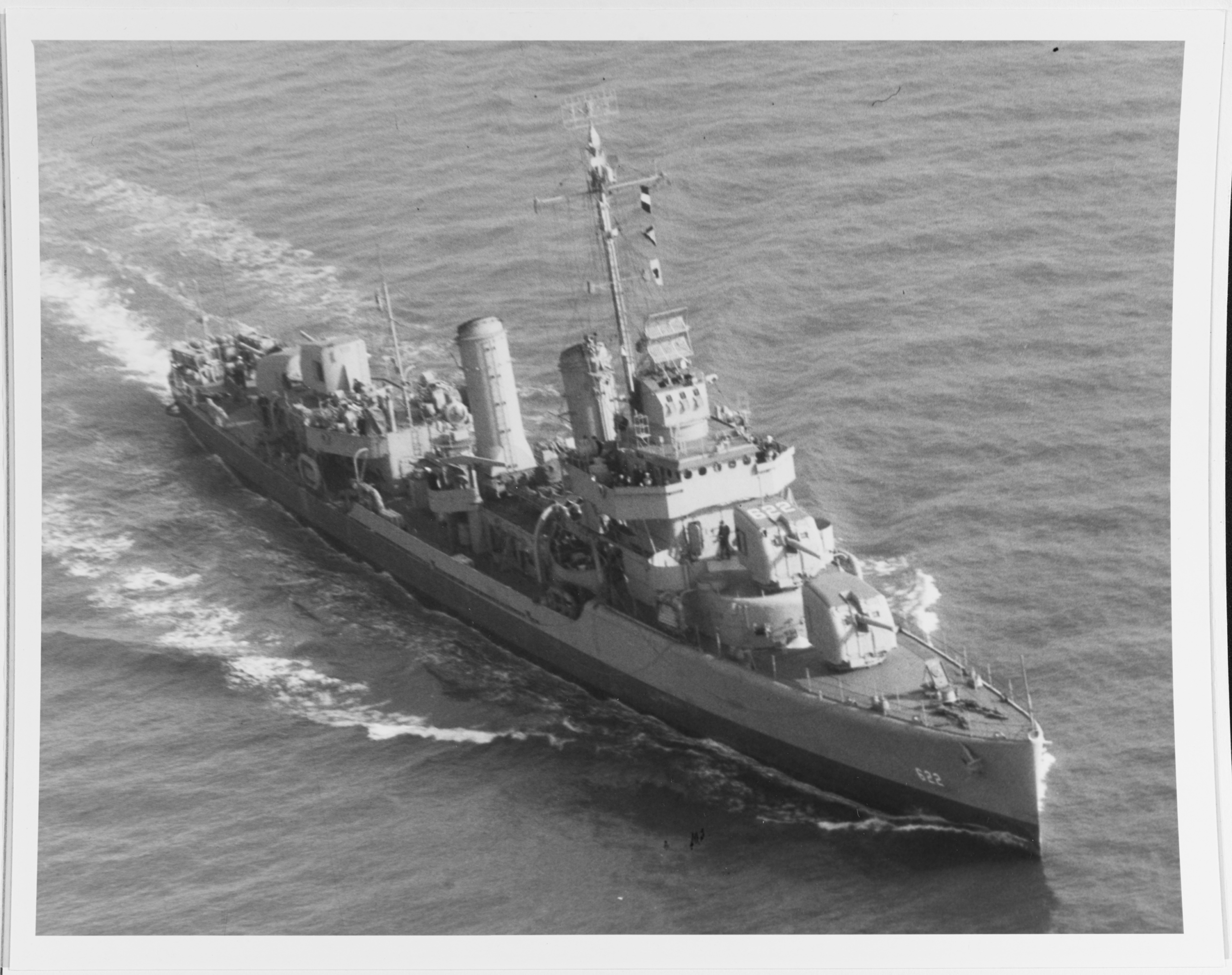
In 1943, the Maddox took part in Operation HUSKY, the Allied invasion of Sicily. The invasion began on 10 July 1943 and marked one of the largest amphibious operations of the war to that point. Allied leaders viewed Sicily as a critical stepping stone toward the invasion of mainland Italy and the weakening of Axis control in the Mediterranean.
During the early hours of the invasion near Gela, Sicily, Allied naval forces came under heavy attack from Axis aircraft. Just before dawn on 10 July 1943, enemy bombers struck the Maddox directly. The destroyer rolled over and sank in only two minutes. The suddenness of the attack left many sailors with little chance to escape.
A total of 209 crewmen, including Seaman Second Class Stanley Waskiewicz, were reported missing in action. Survivors of the sinking remained in the water for at least two hours before rescue vessels arrived to pick them up. For many families at home, the uncertainty surrounding sailors listed as missing created months and sometimes years of painful waiting.
Because Stanley was lost at sea and never recovered, the military later established his official date of death as 11 July 1944, one year and one day after the sinking of his ship. He is memorialized today on the Tablets of the Missing at the Sicily-Rome American Cemetery and Memorial, where the names of Americans missing in the Mediterranean theater are inscribed in honor of their sacrifice.
For his service, Stanley posthumously received the Purple Heart. He was also eligible for the American Campaign Medal, the World War II Victory Medal, and the European-African-Middle Eastern Campaign Medal.
The Waskiewicz family’s contribution to the war effort did not end with Stanley’s loss. On the very same day that the Maddox was bombed off Sicily, Stanley’s oldest brother Henry enlisted in the Navy. Henry went on to serve in the Pacific Theater aboard USS LST-1044 and remained in service until his discharge on 5 November 1945. Their brother Theodore also survived the war. Serving as a Private First Class in Company E of the 325th Glider Infantry, Theodore spent time in England before being discharged on 1 October 1945.
The story of Stanley Ernest “Bandy” Waskiewicz reflects the experience of many American families during World War II—families of immigrants whose sons answered the call to serve in multiple branches of the military, often at great personal cost. Stanley’s life was brief, and much about him remains unknown today, but his service aboard the USS Maddox placed him among the thousands of sailors who helped carry the war into Europe during one of the conflict’s pivotal campaigns.
This story is part of the Stories Behind the Stars project www.storiesbehindthestars.org This is a national effort of volunteers to write the stories of all 400,000+ of the US WWII fallen here on Fold3. Can you help write these stories? If you noticed anything missing in this profile, you may contact the author. Click on the author’s name located at the bottom of the story page next to the words “added by.”
- SBTSProject/Illinois/LaSalle
- SBTS Historian: Pam Broviak
Sources:
- 1920 U.S. Census, Joseph Waskiewicz, Ancestry.
- 1930 U.S. Census, Joseph Waskiewicz Sr., Ancestry.
- 1940 U.S. Census, Thomas Gorski, Ancestry.
- “St. Mary of the Angels, Chicago, Cook, Illinois, United States records,” images, FamilySearch (https://www.familysearch.org/ark:/61903/3:1:S3HT-DCW4-ZCY : 5 May 2026), image 259 of 276; Marriage Waskiewicz and Lipinski, 1908, Catholic Church. St. Mary of the Angels (Chicago, Illinois). Image Group Number: 004284941
- “U.S., World War II Draft Cards Young Men, 1940-1947,” Theodore Francis Waskiewicz, Ancestry.
- “U.S., World War II Draft Cards Young Men, 1940-1947,” Joseph Francis Waskiewicz, Ancestry.
- “U.S., World War II Draft Cards Young Men, 1940-1947,” Henry Frank Waskiewicz, Ancestry.
- “U.S., World War II Navy Muster Rolls, 1938-1949,” USS Maddox, 30 November 1942, Stanley Ernest Waskiewicz, Ancestry.
- “U.S., World War II Navy Muster Rolls, 1938-1949,” USS Maddox, 1 January 1943, Stanley Ernest Waskiewicz, Ancestry.
- “U.S., World War II Navy Muster Rolls, 1938-1949,” USS Maddox, 1 July 1943, Stanley Ernest Waskiewicz, Ancestry.
- “U.S., World War II Navy Muster Rolls, 1938-1949,” USS Maddox, July 1943, Stanley Ernest Waskiewicz, Ancestry.
- “US, American Battle Monuments Commission, 1914-1950,” S E Waskiewicz, Fold3.
- Vice Admiral H.K. Hewitt, U.S. Navy, “ACTION REPORT WESTERN NAVAL TASK FORCE, THE SICILIAN CAMPAIGN; OPERATION “HUSKY” JULY-AUGUST, 1943, Naval History and Heritage Command.
- “Today in Naval History July 10, 1943,” Naval History Heritage Command.
- “Casualties: U.S. Navy and Coast Guard Vessels, Sunk or Damaged Beyond Repair during World War II, 7 December 1941-1 October 1945, Naval History and Heritage Command.
- “With our Armed Forces,” The Tryon Daily Bulletin, 21 December 1943, p. 8, col. 1, Newspapers.com.
- “S.E. Waskiewicz Missing, Three Brothers Serve,” Daily Post Tribune, Tri-City Section, 25 March 1944, p. 14, col. 1.
- “US, World War II Navy Muster Rolls, 1938-1949, LST 1044, 1945,”10 October 1945, Henry Frank Waskiewicz, Fold3.
- “U.S., Department of Veterans Affairs BIRLS Death File, 1850-2010,” Henry Frank Waskiewicz, Ancestry.
- “U.S., World War II Army Enlistment Records, 1938-1946,” Theodore F. Waskiewicz, Ancestry.
- “U.S., World War II Army Enlistment Records, 1938-1946,” Joseph F. Waskiewicz, Ancestry.
- “U.S., Department of Veterans Affairs BIRLS Death File, 1850-2010,” Theodore F. Waskiewicz, Ancestry.
- Record Group 64: Records of the National Archives and Records Administration Series: Morning Reports, Morning Reports for November 1944: Roll 543, image 2009 of 4146, NARA.
- Record Group 64: Records of the National Archives and Records Administration, Series: Morning Reports, Morning Reports for September 1943: Roll 117 (3 of 4), image 30 of 1000, NARA.
- https://www.findagrave.com/memorial/56315603/stanislaus-ernest-waskiewicz
