Early Years
Michael Stanley Krystofek came into the world on 5 September 1907, in Peru, Illinois—a small city along the Illinois River—the fifth child of Polish immigrants Stanley and Sophia Krystofek. His parents had made the long journey from Poland to America in the 1890s, married in LaSalle County in February 1897, and built a life rooted in hard work and family. By the time Michael arrived, he already had four older siblings: Joseph, Mary, John, and Anthony. The family would eventually grow to nine children, with the arrivals of Frances, Josephine, Anna, and finally young Stanley in 1919.
The Krystofeks were a working-class family. In 1910, they lived at 1516 Walnut Street, and Stanley senior labored in the coal mines to support his growing household. By 1920, the family had moved to 515 Illinois Street, and Stanley was still mining. When he died on 11 June 1928, he left behind Sophia and their children. Two years later, Sophia was the head of a home she owned at 715 Ninth Street, and Michael—then in his early twenties—was contributing to the household as a general laborer, as were several of his siblings.
By 1940, Michael had found steady and meaningful work at the Manteno State Hospital, a psychiatric facility in Kankakee County. He lived and worked there, and whatever he learned about caring for vulnerable people in that setting would prove quietly significant in the years ahead.
Off to War
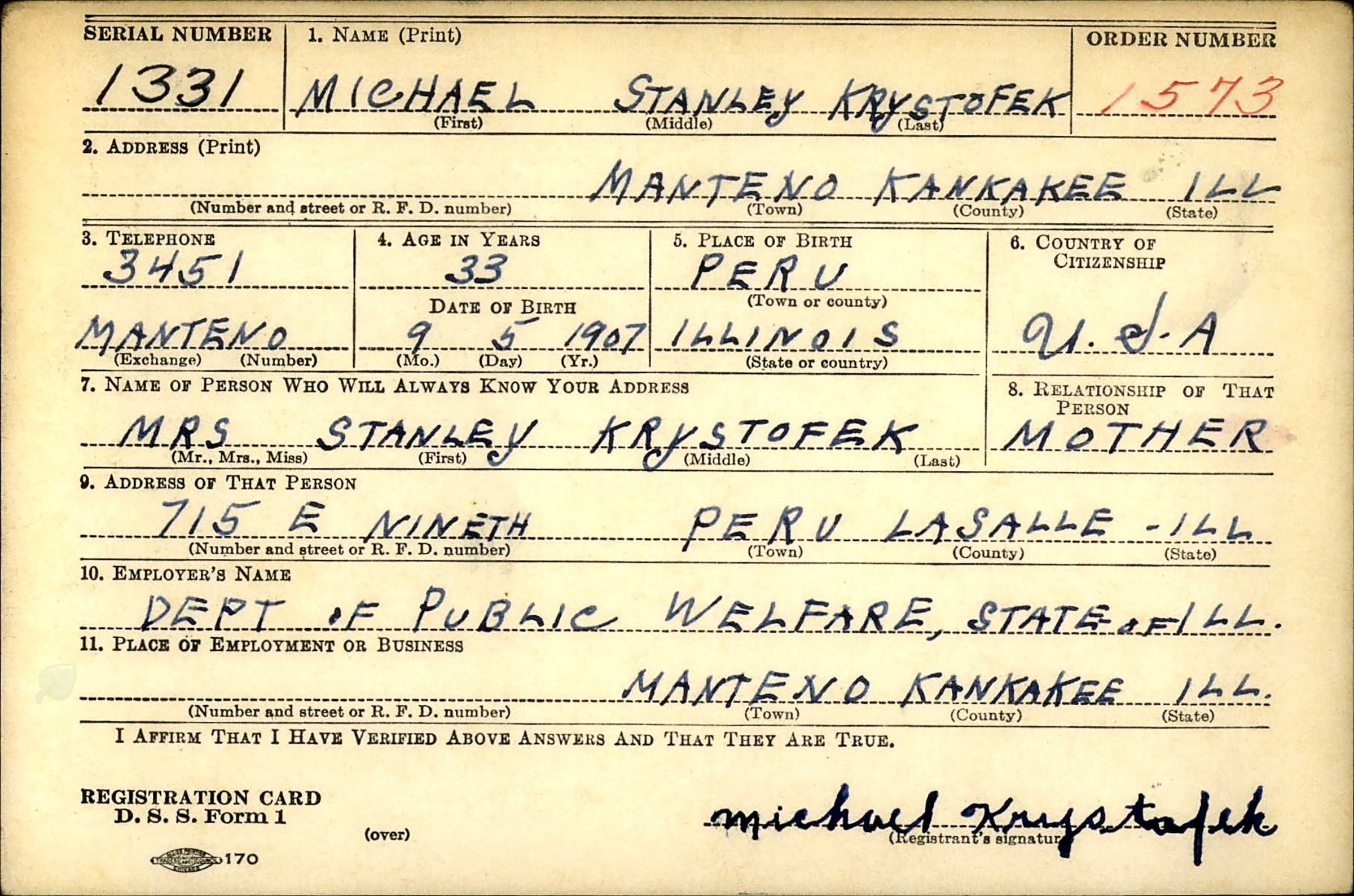
When the United States entered World War II, the Krystofek family answered the call together. Michael, then 33 years old, had already registered for the draft on 16 October 1940—the same day as his younger brother Stanley, 21, and his older brother Anthony, 35. When enlistment came, the brothers went in close succession. Anthony enlisted on 9 March 1942. Michael followed nine days later, on March 18, enlisting in Chicago. Stanley came a few months after, on May 5.
Michael stood 5 feet 5 inches tall, weighed 145 pounds, and had brown hair and brown eyes. He was sent first to Camp Grant for basic training, then to Camp Shelby in Mississippi. He was assigned to Company C of the 120th Medical Battalion, part of the 45th Infantry Division. From there, his training took him through Louisiana, Texas, and finally to Camp Carrabelle in Florida, where soldiers trained for amphibious landings.
His assignment as a Medical Corpsman (MOS 657) suited him. The role called for men who could serve as hospital orderlies, litter bearers, ambulance drivers, and first-aid providers. They made beds, cleaned facilities, and kept equipment ready. They went where the wounded were, often under fire. Michael’s years at Manteno State Hospital had already given him a grounding in institutional care and steady hands around those who were suffering.
Into the Fight
The 45th Infantry Division deployed to North Africa, then pushed through Sicily and into Italy before moving into France. Throughout the campaign, the 120th Medical Battalion did the quiet, relentless work of evacuating casualties and keeping men alive long enough to receive proper care.
During the time his unit was in Italy, Michael was able to visit his brother Anthony, who was also serving in a medical corps unit—the 300th General Hospital. Two brothers, both in the business of saving lives, finding each other briefly in the middle of a war.
By mid-October 1944, Michael’s unit was in the Vosges region of northeastern France, moving with the 45th Infantry Division toward the Mortagne River. It had been raining consistently, and the roads and fields were heavy with mud. German snipers had positioned themselves throughout the area, and they fired on American soldiers relentlessly — including the medics, who wore the Red Cross of the Geneva Convention on their helmets and armbands.
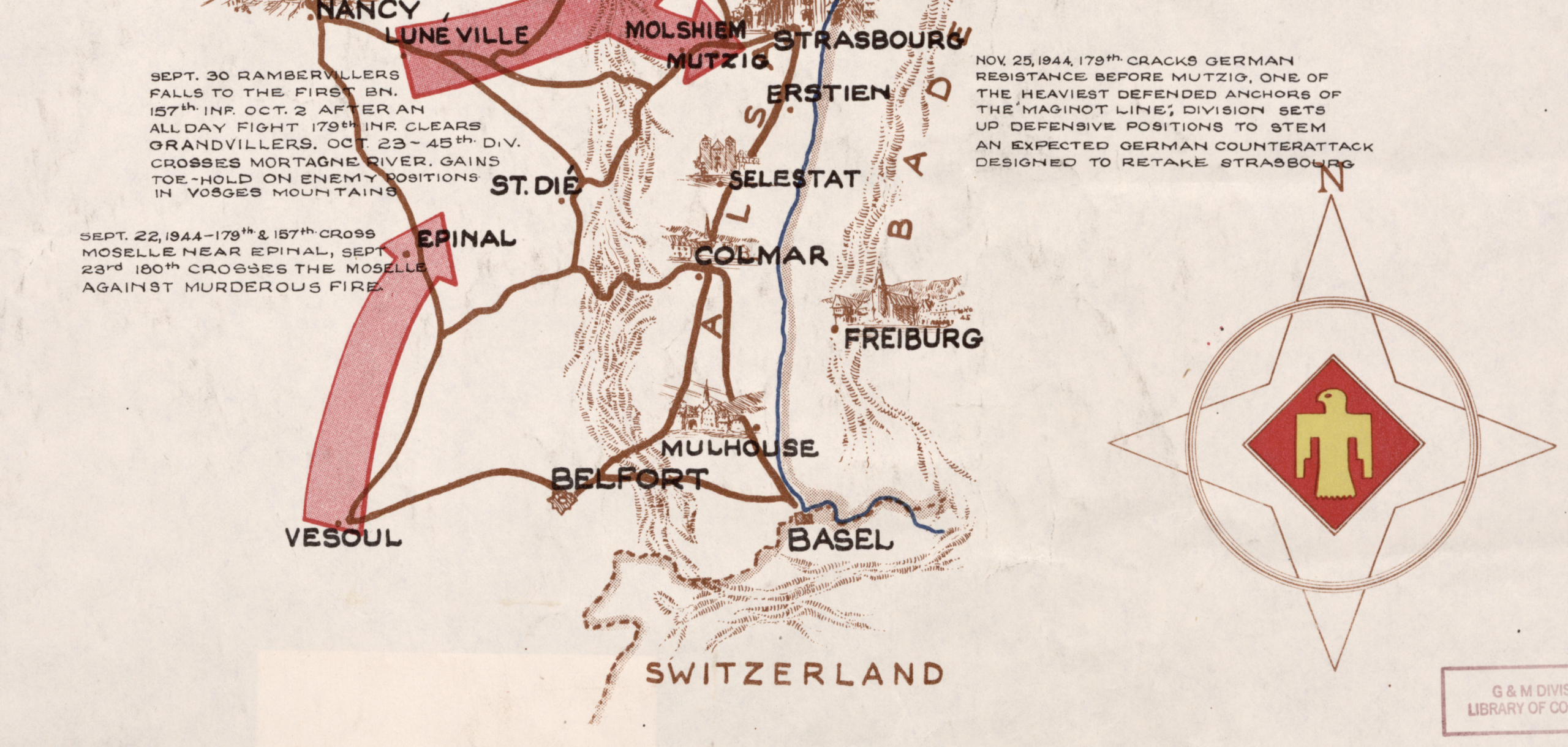
On 17 October 1944, at 3:30 in the afternoon, PVT Michael Stanley Krystofek was at work doing what he had been trained to do—collecting wounded soldiers from the field. He was in the act of placing an injured man onto a litter, a half mile northeast of Fremifontain, France, when a sniper’s bullet struck him in the head.
He was 37 years old.
Michael was buried on 21 November 1944, in a cemetery near Épinal, France. In 1948, his remains were moved to a permanent resting place: Plot A, Row 3, Grave 48, in the Épinal American Cemetery and Memorial.
A Grieving Family
Back home in Peru, his mother Sophia received his personal belongings—a souvenir edition of a newspaper, letters he had written or carried, a Bible and rosary, a ring, a wallet, photographs, a brooch pin, campaign ribbons and stars, and seventy-two cents.
PVT Michael Krystofek was posthumously eligible for the Army Good Conduct Medal, the American Campaign Medal, the World War II Victory Medal, and the European-African-Middle Eastern Campaign Medal.
His brothers came home. Anthony was discharged on 23 August 1945. Stanley, who had trained as an airplane mechanic and propeller specialist and served in the Pacific Theater with the 344th Service Squadron, was discharged on 31 December 1945.
Michael did not come home. He had gone to war as a man who cared for others—first at a hospital in Illinois, then across North Africa, Sicily, Italy, and France—and he died doing exactly that: trying to get a wounded soldier safely onto a litter, in the mud and rain of the Vosges, while snipers fired from the trees.
This story is part of the Stories Behind the Stars project www.storiesbehindthestars.org This is a national effort of volunteers to write the stories of all 400,000+ of the US WWII fallen here on Fold3. Can you help write these stories? If you noticed anything missing in this profile, you may contact the author. Click on the author’s name located at the bottom of the story page next to the words “added by.”
- SBTSProject/Illinois/LaSalle
- SBTS Historian: Pam Broviak
Sources:
- 1910 U.S. Census, Stanlislaus Krystofek, Ancestry.
- 1920 U.S. Census, Stanley Krystofek, Ancestry.
- 1930 U.S. Census, Sophia Krystofek, Ancestry.
- 1940 U.S. Census, Michael Krystofek, Ancestry.
- “Illinois, U.S., Marriage Index, 1860-1920,” Stanislaw Krystofek to Sophia Czurkot, Ancestry.
- “Illinois, Births and Christenings, 1824-1940”, Mike Krystofek, FamilySearch.
- “Illinois, U.S., Deaths and Stillbirths Index, 1916-1947,” Stanislaw Krzystofek, Ancestry.
- “U.S., World War II Draft Cards Young Men, 1940-1947,” Michael Stanley Krystofek, Ancestry.
- “U.S., World War II Draft Cards Young Men, 1940-1947,” Stanley Casimer Krystofek, Ancestry.
- “U.S., World War II Draft Cards Young Men, 1940-1947,” Anthony S. Krystofek, Ancestry.
- “U.S., World War II Army Enlistment Records, 1938-1946,” Michael S. Krystofek, Ancestry.
- “U.S., World War II Army Enlistment Records, 1938-1946,” Stanley C. Krystofek, Ancestry.
- Individual Deceased Personnel File (IDPF), Michael Krystofek, Service No. 36395608, NARA.
- Morning Reports for November 1944: Roll 657, Co C 120 Med. BN., image 3192 of 3690, 19 November 1944, NARA.
- Morning Reports for July 1944: Roll 462 (1 of 4),” 344th Service Squadron, 4 July 1944, image 742 of 1000, NARA.
- “The WW2 Medical Battalion, Infantry Division,” WW2 US Medical Research Center.
- “WW2 Medical “MOS” Definitions,” WW2 US Medical Research Center.
- “Operations Report, 120th Medical Battalion, 10 November 1944,” Metropolitan Library System Special Collections & Research.
- “Morning Reports for June 1944: Roll 517 (1 of 4),” 24 June 1944, 300th General Hospital, image 729 of 1000, NARA.
- “U.S., Department of Veterans Affairs BIRLS Death File, 1850-2010,” Stanley C. Krystofek, Ancestry.
- “U.S., Department of Veterans Affairs BIRLS Death File, 1850-2010,” Anthony Stanley Krystofek, Ancestry.
- “Three Krystofek Brothers Serve, All are Overseas,” The Daily Post Tribune, 25 March 1944, Stars and Stripes Edition, Peru, p. 5, cols. 5–6.
- https://www.findagrave.com/memorial/56373602/michael-stanley-krystofek
