James “Jimmy” Joseph Riedel entered the world on 9 April 1925, in the city of Peru, born to Joseph and Elizabeth (Wilson) Riedel. He was the younger of two sons, joining older brother Kenneth, who had been born eight years earlier in 1917. Before marriage and family life, Jimmy’s father had been known locally as a catcher for the Peru Maroons baseball team, part of the strong athletic culture that was common in Illinois Valley towns during the early twentieth century. Joseph married Elizabeth Wilson in June 1916 and soon began building a life centered around work, home, and family.
Yet in the years before Jimmy’s birth, tragedy had touched the Riedel family. In 1916, Joseph’s sister Frieda drowned at the swimming pool at Starved Rock State Park. A few years later, in 1923, another serious accident struck the family when Joseph’s sister Grace Phillips was badly injured in an automobile crash west of Spring Valley. Jimmy’s mother Elizabeth and his older brother Kenneth were also in the vehicle but survived. Grace Phillips suffered a fractured skull and broken jaw and was initially not expected to live, though she eventually recovered. Her infant son Henry, only six weeks old at the time, escaped injury.
By 1930, the Riedel family lived in a home they owned at 1815 Eighth Street in Peru. Joseph worked as a foreman at the Maze Nail Factory, one of the many industrial employers that helped define life in the Illinois Valley during that era. Sometime after 1930, the family moved to another home at 2817 Fifth Street. In 1940, Joseph was employed as a foreman with the Maze Lumber Company, while Kenneth worked there as a machinist. Jimmy, meanwhile, was still attending school and played football, joining many young men of his generation whose school years unfolded beneath the growing shadow of world war overseas.
Like countless American teenagers during the Second World War, Jimmy answered the call to military service while still very young. On 4 March 1943, a month before turning 18, he enlisted in the Naval Reserve in Chicago. That August, he reported aboard the destroyer USS Macomb (DD-458).
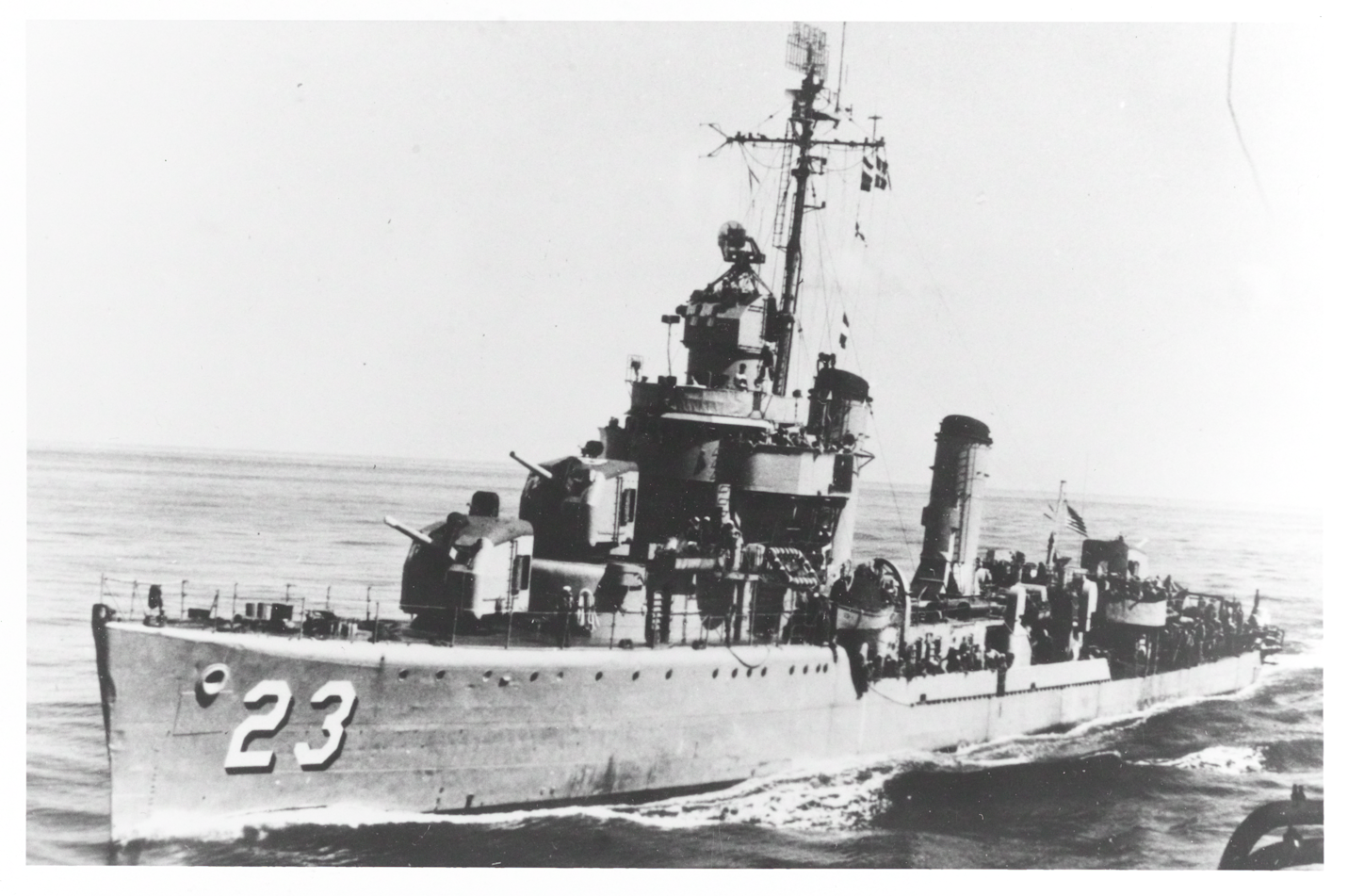
The Macomb initially served along the Atlantic coast conducting escort and antisubmarine operations during a period when German U-boats still threatened Allied shipping. In mid-1944, the ship deployed to the Mediterranean, operating off the Algerian coast on antisubmarine patrols. That summer, the Macomb participated in Operation Dragoon, the Allied invasion of southern France launched in August 1944. Following the invasion, the ship resumed patrol and escort duties in the Mediterranean.
Late in 1944, the Macomb returned to the United States for conversion into a destroyer minesweeper. Redesignated DMS-23, the vessel joined Mine Squadron 20 and prepared for service in the Pacific Theater, where the war had entered its final and most destructive phase. In January 1945, the Macomb sailed westward, arriving in the Pacific in March as American forces prepared for the invasion of Okinawa.
The Okinawa campaign became one of the deadliest naval operations of the war. Minesweepers operated in especially dangerous waters because they cleared paths for invasion forces while remaining exposed to constant attack. Mine Squadron 20 suffered heavily during the campaign. Of the squadron’s eleven ships, all but one were struck by kamikaze attacks. On 6 April 1945, the destroyer minesweeper USS Emmons (DMS-22) was so badly damaged by kamikazes that she later had to be scuttled. Altogether, the squadron sustained roughly 300 casualties, including more than 100 men killed.
On 3 May 1945, while operating near Point Bold off Okinawa, a Japanese suicide aircraft crashed into the USS Macomb (DMS-23). Among those listed as missing in action after the attack was Ship’s Cook Third Class James Joseph Riedel. He was 20 years old.
For its service during the Okinawa campaign, the Macomb later received the Navy Unit Commendation, recognized for having, “…by her own aggressiveness and the courage and skill of her officers and men, contributed essentially to the success of the Okinawa invasion…”
James was posthumously eligible for the American Campaign Medal, the Asiatic-Pacific Campaign Medal, and the World War II Victory Medal. Though his remains were never returned home, his memory endured in Peru. A cenotaph honoring him was later placed on the gravestone of his parents in Peru City Cemetery, where his name stands alongside theirs—a lasting reminder of a young sailor from Peru who never returned from the war.

This story is part of the Stories Behind the Stars project www.storiesbehindthestars.org This is a national effort of volunteers to write the stories of all 400,000+ of the US WWII fallen here on Fold3. Can you help write these stories? If you noticed anything missing in this profile, you may contact the author. Click on the author’s name located at the bottom of the story page next to the words “added by.”
- SBTSProject/Illinois/LaSalle
- SBTS Historian: Pam Broviak
Sources:
- 1930 U.S. Census, Joseph Riedel, Ancestry.
- 1940 U.S. Census, Joseph Riedel, Ancestry.
- “Peru Baseball Player is now Married Man,” Daily Republican Times, Ottawa, Ill., 8 June 1916, p. 6, col. 3, Reddick Library (https://reddick.historyarchives.online : accessed 11 May 2026).
- “Death of Peru Girl is Result of Lads’ Prank,” Daily Republican Times, Ottawa, Illinois, 7 July 1916, p. 1, col. 1, Oldnews.com (https://oldnews.com : accessed 11 May 2026).
- “Peru Woman Dying after Accident,” Daily Republican Times, Ottawa, Ill., 21 July 1923, p. 6, col. 7 , Reddick Library (https://reddick.historyarchives.online : accessed 11 May 2026).“U.S., World War II Draft Cards Young Men, 1940-1947,” Kenneth W. Reidel, Ancestry.
- “U.S., Social Security Applications and Claims Index, 1936-2007,” Elizabeth M. Riedel, Ancestry.
- “U.S., World War II Navy Muster Rolls, 1938-1949,” USS Macomb, 10 May 1945, No 5, James Joseph Reidel, Ancestry.
- “Muster Roll of the Crew,” USS Macomb, 30 September 1943, James Joseph Riedel, Fold3.
- “Macomb (DD-458),” Naval History and Heritage Command.
- Individual Deceased Personnel File, James Joseph Riedel, NARA.
- https://www.findagrave.com/memorial/102103165/james-joseph-riedel
